The digital landscape is undergoing a seismic shift. For decades, we have optimized content for search engine algorithms that retrieve lists of links based on keywords. Today, we face a new challenge: optimizing for Large Language Models (LLMs) and generative AI engines like ChatGPT, Gemini, and Perplexity.
When a user asks an AI a question, they aren’t looking for ten blue links; they are looking for a synthesized, accurate answer. If your brand isn’t understood by these models, it won’t just rank lower—it might be excluded from the conversation entirely.
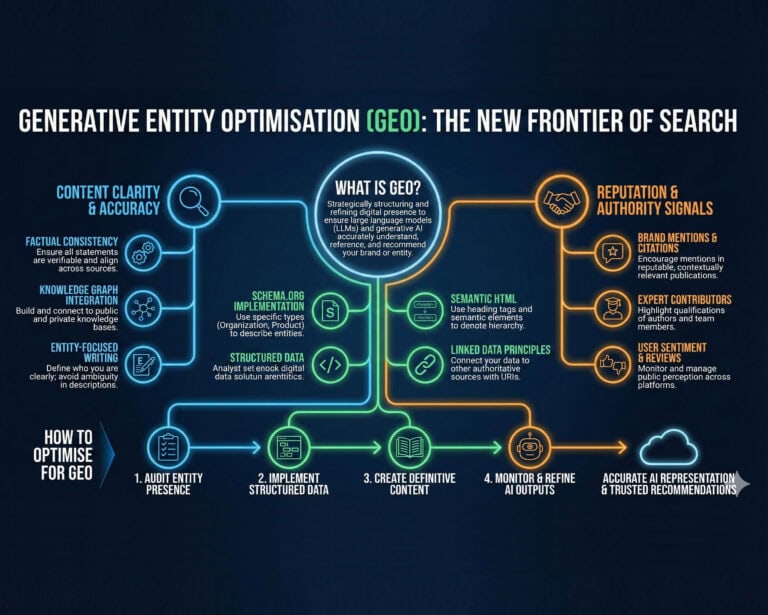
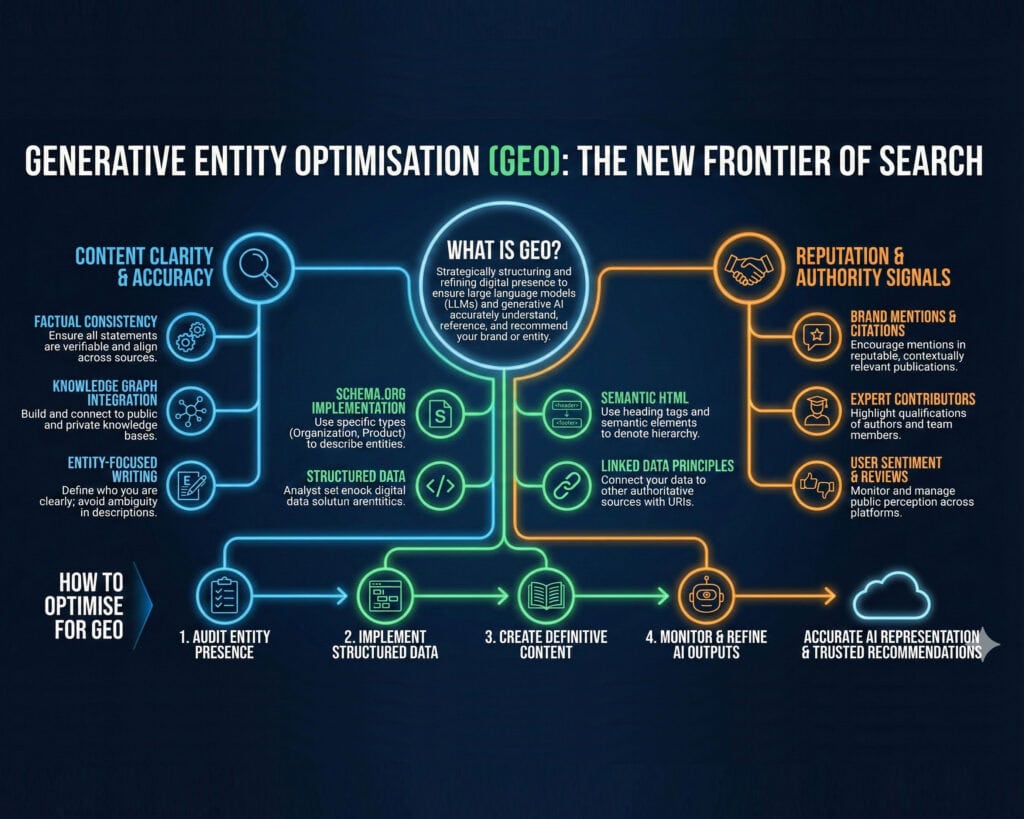
This is where Generative Entity Optimization (GEO) enters the frame. It is the practice of shifting our focus from “strings” (keywords) to “things” (entities).
Here is a breakdown of what GEO is and the core pillars required to ensure your brand is accurately recognized, understood, and recommended by the next generation of search tools.
What is GEO?
Generative Entity Optimization is the strategic process of structuring and refining your digital presence to ensure AI models accurately understand who you are, what you do, and how you relate to other concepts online.
AI models build massive internal “knowledge graphs”—networks connecting facts, people, places, and organizations. If traditional SEO was about convincing Google your page was relevant to a keyword, GEO is about convincing an AI model that your brand is a verifiable “entity” and a definitive source of truth regarding your specific topics.
To do this, we must speak the language machines understand best. This requires a strong technical foundation built on four interconnected concepts:
1. Semantic HTML
Before AI can understand the nuance of your content, it must understand the structure of your webpage. Semantic HTML goes beyond making things bold or italic; it uses specific HTML tags to define the meaning of different parts of a document. By using correct tags like <article> for main content, <nav> for navigation, <aside> for secondary information, and proper heading hierarchies (<h1> through <h6>), you provide clear signposts that help AI crawlers differentiate between core information and boilerplate noise.
2. Structured Data
While humans can read a paragraph and easily identify a product’s price, an event’s location, or a recipe’s cook time, AI needs explicit instructions to do the same accurately. Structured Data is the concept of organizing information into highly standardized formats that machines can easily parse. Instead of locking data inside paragraphs of text, you present it as organized fields and values. It is the difference between a messy, handwritten note and a neatly organized spreadsheet row.
3. Schema Markup
If “Structured Data” is the concept, “Schema Markup” is the specific vocabulary used to implement it. Maintained by Schema.org, it is a universal code language accepted by major search engines and AI developers. By adding Schema code (usually in JSON-LD format) to your site, you explicitly tell the AI: “This text string isn’t just numbers; it is the telephone number for this specific Organization entity.” It removes ambiguity, allowing the AI to confidently classify your content as a Product, Person, Event, or FAQ.
4. Linked Data
Linked Data is the glue that connects your entity to the wider web of knowledge. It involves using unique identifiers (URIs) to connect facts on your website to external, trusted sources of authority, such as Wikipedia, Wikidata, or reputable government databases. By linking your local definitions of “climate change” or “financial regulation” to universally accepted definitions elsewhere, you anchor your content to established facts. This helps disambiguate your brand from others with similar names and solidifies your place in the global knowledge graph.
Content Clarity & Accuracy is Key Going Forward
The technical scaffolding above is useless if the content it supports is vague or incorrect. Generative AI models are trained to prioritize factual accuracy and reduce “hallucinations.” Therefore, GEO requires writing with extreme clarity.
Your content needs to be definitive. Avoid ambiguous language and ensure that nouns and entities are clearly defined within the text. Furthermore, factual consistency is paramount; if your “About Us” page contradicts your Wikipedia entry or your LinkedIn profile, the AI will downgrade its confidence in your entity. To become a trusted source that AI cites in its answers, your content must be verifiable, consistently accurate across platforms, and easy for a machine to digest without misinterpretation.
Reputation & Authority Signals Will Matter Most
Just like traditional SEO’s concept of E-E-A-T (Experience, Expertise, Authoritativeness, and Trustworthiness), GEO relies heavily on external validation. AI models determine the credibility of an entity by analyzing what the rest of the web says about it.
Building authority for GEO means earning mentions and citations from other reputable, contextually relevant entities in your niche. It involves highlighting the qualifications and expertise of your individual authors through comprehensive bios and associated personal schemas. Furthermore, managing public sentiment—reviews, forums discussions, and social chatter—is crucial. Positive, organic sentiment across the web acts as social proof to the AI that your entity is a recognized leader worthy of being recommended to users.
Speak to Us if You Need Help With SEO and Online Marketing
As search engines evolve, your practice cannot afford to be invisible to the next generation of patients. Optimizing for GEO requires a blend of technical expertise and industry authority—the exact foundation Direct Response PT is built upon. Whether you need to refine the SEO for your Physical Therapy clinic or are launching a new medical venture, we have the tools to make sure you are heard loud and clear. Do you have questions about your current strategy? Contact us today to discuss how we can elevate your online marketing.

Shayne Nowikow
Latest posts by Shayne Nowikow (see all)
- Why ChatGPT Ads Are the Next Big Shift for Medical Marketing - 27th January 2026
- GEO and The New Frontier of Search in the Age of AI - 28th November 2025
- Have you heard of Edge SEO? - 1st November 2024