Healthcare is obsessed with speed—instant bookings, AI triage, automation everywhere.
But the faster it moves, the more patients crave something slower: human attention.
Because what people remember isn’t the software. It’s the moment a clinician slows down, listens, and makes them feel seen.
That’s the paradox of modern care: technology should make clinicians slower with people—more present—because it makes everything else faster.
Slow Health isn’t anti-tech. It’s pro-attention. Automate the admin; humanize the encounter.
This idea echoes the growing Slow Medicine movement — an international philosophy of care that prioritizes time, listening, and individual attention over rushed efficiency (PubMed).
As one review put it, “Slow Medicine means making time to listen and consider the whole person, not just the disease.” (PubMed)
But there’s an uncomfortable truth hiding inside that idea:
If you believe your clinic delivers more honest attention, clearer guidance, and better outcomes…
you have a duty to find more patients and help more of them — to drag them out of the clutches of hospitals and PT mills that treat people like data, not humans.
Because if you don’t, they’ll end up somewhere that values throughput over thought, speed over skill, and protocol over presence.
What gets in the way
- Invisible clinics. Great practitioners whisper; loud competitors shout. Guess who the patient finds first?
- Lead leakage. Missed calls, slow replies, forgotten follow-ups—the patient gives up and goes elsewhere.
- Inconsistent proof. Stories live in clinicians’ heads instead of in public: outcomes, testimonials, simple before/after narratives.
What “better marketing” really means
Not hype. Not gimmicks. Better marketing is simply clearer paths to care:
- One clear promise per campaign (e.g., “gentle, evidence-based relief for shoulder pain”).
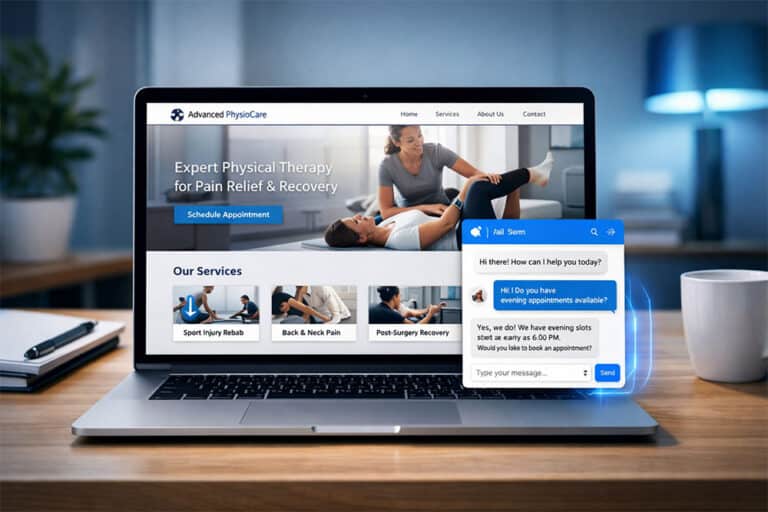
- Fast, kind follow-up—text within minutes, not days.
- Friction-light booking (and reminders to reduce no-shows).
- Real social proof—short patient stories that show progress, not perfection.
- Consistent presence so you’re discoverable the moment someone finally decides to act.
Do that, and technology becomes moral: it rescues time from admin so clinicians can spend it where it matters—face to face.
A handy tip for reclaiming your time
Clinicians don’t just lose time to missed calls or clunky marketing systems. Many still spend hours every week typing up treatment notes or rewriting what they already said in the room.
But now, with consent, clinicians can simply record sessions and let AI generate SOAP notes, summaries, or insurance-ready documentation automatically.
Some tools even sync directly with EMRs—so the clinical record writes itself while you stay focused on the patient.
The technology is here.
The question is: how many are actually using it?
How many brilliant practitioners are still spending late nights at their desks, doing paperwork the old way, while their attention—and energy—could be used to care, create, or grow?
The Practical Frame
- Use automation for the journey to the room (ads, lead capture, instant text-back, reminders).
- Use humans for the time in the room (listening, reasoning, reassurance).
- Measure both. If the diary is thin, you can’t deliver Slow Health at scale. If the diary is full of the wrong cases, you burn out.
The Quiet Conclusion
Slow Health asks you to give patients your undivided attention.
Better marketing makes sure the right patients can find it.
If you’re proud of how you treat people, don’t hide.
Show up. Speak plainly. Follow up quickly. Make it easy to start.
Because in 2025, the ethical clinic isn’t just the one that cares deeply inside the appointment—it’s the one that cares enough to be found.
Because helping more people isn’t marketing — it’s medicine. 😀

Flemming Arnott
Latest posts by Flemming Arnott (see all)
- Why isn’t my physical therapy website generating new patients? - 28th July 2026
- Why Website Visitors Don’t Contact Your Clinic (And What To Do About It) - 15th April 2026
- The Real Reasons Many Small Business Websites Hold Growth Back - 30th December 2025