Why Your Physical Therapy Website Isn’t Turning Visitors Into Patients
Most physical therapy websites lose leads not because they lack visitors, but because the site gives those visitors no easy, low-pressure way to take the next step. Five leaks account for the bulk of it: too little trust, weak calls to action, a generic contact form, only one way to get in touch, and confusion about what to do next. Plug those, give people a smaller first step than “book now,” and the same traffic starts producing far more inquiries.
Here’s the thing most conversion advice gets wrong, though. It assumes your visitors arrived ready to book and just need a firmer nudge. Most of them didn’t. Picture a hundred people landing on your site this month: maybe four book and two call — and the other ninety-four leave without a trace. It’s tempting to read that as ninety-four people who weren’t interested. They were interested; they searched for you. What they weren’t was ready, and your site only offered one action — the biggest one on the menu.
That’s the leak underneath the five leaks. A website with a single door converts the people who showed up ready to walk through it, and quietly loses everyone else. The fix isn’t asking louder. It’s offering a range of steps, sized to how ready someone actually is.
Below are the five most common leaks, how to fix each, and what to do about the visitors who aren’t ready to book yet.
What actually counts as a lead?
A lead is not simply a website visitor. It’s someone who has taken an action — requested a guide, filled in an inquiry form, started a chat — and handed you their contact details, giving you permission to begin turning them into a patient.
Every visitor who leaves without doing that is a lead you didn’t capture. The whole job of your website is to move as many visitors as possible across that line, so a small lift in conversion is a direct lift in patients and revenue. Worth noticing: crossing that line doesn’t have to mean booking. Someone who asks a question is now a lead. That distinction is what the rest of this article turns on.
Leak 1: Your site doesn’t build enough trust
People don’t reach out to a clinic they don’t yet trust, and a website earns that trust in the first few seconds. An intro video of the clinic owner talking directly to the camera does more than any amount of polished design — one person speaking to another is what builds a human connection.
Back it with social proof: reviews and, better still, video testimonials from patients of the same age, town, and problem as the visitor. Trust is a big enough topic that it has its own guide — how to make your clinic website trustworthy enough to book — and collecting the reviews that power it is covered in building a steady stream of 5-star reviews.
Leak 2: Weak or missing calls to action
Never be afraid to tell people what to do next — think of it as giving them permission to act. Clear call-to-action buttons, placed throughout the page, remove the uncertainty that stops people reaching out.
Every page should carry at least one, and most should point to your main goal: filling in an inquiry form. Something as plain as “Inquire About Cost & Availability” works better than a vague “Contact Us,” because it tells the visitor exactly what happens when they click — and, just as importantly, how much they’re committing to. “Book Now” and “Ask a Question” are very different sizes of ask, and the wording is where a visitor decides whether the step is small enough to take.
Leak 3: A generic contact form
A single catch-all form for every type of inquiry quietly loses people, even if it offers a drop-down to pick a topic. Once someone trusts you enough to reach out, a bland form asks them to do the thinking, and many won’t bother.
Build a dedicated inquiry form instead. Ask engaging questions, and use multiple-choice fields wherever possible so visitors can answer quickly without composing sentences — every extra moment of effort is a chance to lose them. A form is a size of ask too: each additional field you require makes the step bigger, and somewhere in there a proportion of people quietly decide it isn’t worth it.
Leak 4: Only one way to get in touch
An inquiry form should never be the only door. Some people would rather call, some prefer email, some want live chat, and some will only ever use a messenger app — and if you don’t offer their preferred channel, you lose them.
But channel isn’t only about preference; it’s about commitment. Warmer leads, ready to become patients, will fill in a form. Colder ones often prefer chat precisely because it feels like less of a promise — you can ask one question and disappear, which is exactly what someone still deciding wants to do. An AI live chat assistant is a good way to catch those hesitant visitors instantly, even outside business hours.
Leak 5: Visitors are confused about the next step
Confused visitors don’t act — they leave, often for a competitor, and you never see them again. Too much information, cluttered navigation, and no clear next step all create that confusion.
Slow pages compound it: Google’s Core Web Vitals reflect how many visitors give up before a page even loads. Look at your site as a skeptical newcomer would and ask whether it clearly says who you help, and makes the next step obvious and easy.
Worth being precise here, because it’s easy to over-correct: each page should still have one obvious primary action. Offering a range of steps doesn’t mean cluttering a page with five competing buttons — that’s this very leak. It means the site as a whole gives people more than one size of ask, while any single page stays clear about what it wants. That’s why ad traffic goes to a dedicated landing page with exactly one action rather than to a homepage juggling all of them.
What if a visitor isn’t ready to book yet?
This is the leak that costs the most, because it’s invisible. Not everyone who lands on your site is ready to schedule, and treating them as if they are is the quietest failure of all. Many are still working out whether you treat their condition, whether they need a referral, what a first visit involves, or what it costs. If booking is the only obvious option, those people simply leave — and nothing in your analytics tells you they were interested.
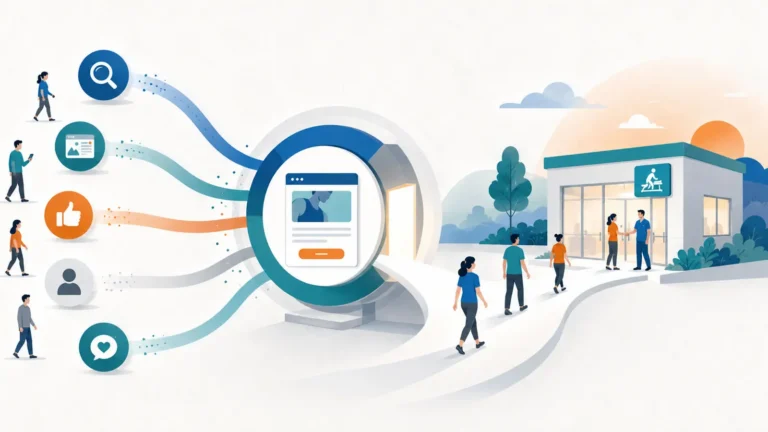
Go back to those ninety-four. The fix isn’t to persuade them harder; it’s to offer a step small enough that being unsure doesn’t disqualify them: ask a quick question, download a guide, start a chat, watch a short video. Each one converts a browser into someone you can actually follow up with. Think of it as a ladder rather than a door — “book an appointment” at the top, “ask us anything” at the bottom, and something at every rung between. The easier that first step feels, the more of the ninety-four stay in the conversation instead of drifting to a competitor.
And a warning worth stating plainly, because I’ve watched clinics undo all this work at the last moment: capturing a lead is only worth something if someone follows up. A ladder that fills with inquiries nobody answers is just a slower leak.
In short
Losing leads is losing money — every visitor is a potential patient worth thousands in lifetime value. Fix the five leaks, then fix the assumption underneath them: your visitors aren’t all ready to book, and a site with one door converts only the few who are. Add smaller first steps for everyone else, and your website starts earning its keep instead of quietly leaking the traffic you paid to attract — which is what building a lead-generation website is really about.
If you’d like a clinic website built to convert rather than just exist, see how we approach websites for physical therapy clinics.
FAQ
What counts as a lead on a physical therapy website?
Someone who reaches out and gives you their contact details — via an inquiry form, guide download, call, or chat — not just a visitor who reads a page and leaves. Note that it doesn’t have to be a booking; a question is a lead.
Why is my website getting traffic but not inquiries?
Usually a conversion problem, not a traffic one: too little trust, weak calls to action, an off-putting form, only one way to make contact, or confusion about the next step. Underneath all five, the common cause is a site that only offers one action — booking — to an audience where most people aren’t ready to book yet.
What if visitors aren’t ready to book yet?
Give them a smaller first step — a question, a guide, a chat, a short video — so you capture the many people who are interested but not ready to commit to an appointment. Most of your traffic is in this group, which is why it’s the single biggest source of lost leads.